How to Secure Your Bitcoin

Last published August 30, 2019
If you’re new to Bitcoin and cryptocurrency, you may have heard the common phrase not your keys not your coins. While self-custody isn’t for everyone, it’s the only way to truly have exclusive control over your funds. If that’s what you’re into, read on.
Dangers of storing your own Bitcoin
To spend your Bitcoin, you need to have access to your wallet or to the seed phrase that was created alongside the wallet. Likewise, an attacker only needs access to one of those two things to steal all your coins.
A seed phrase is essentially the master key to a crypto wallet and usually comes in the form of 12 or 24 words. If you lose your wallet, for example maybe the phone your wallet was on becomes lost, then you can use the seed to regenerate every private key in the wallet and regain access to your Bitcoin.
Example of a BIP-39 seed phrase:
witch collapse practice feed shame open despair creek road again ice least
Methods for securing your Bitcoin seed phrase
Like choosing a wallet, choosing a method to store your seed phrase depends slightly on your technical abilities and personal needs. Let’s go over some options and weigh the pros and cons.
Storing the seed phrase on paper
This is the simplest method, and for many people, it’s a good start.
- Can’t be hacked digitally
- Can be physically stolen
- Free
- Easily destroyed (eaten by a dog, burned, soaked, etc)
- Easily lost, but can be mitigated by using Shamir’s Secret Sharing, which requires more technical knowledge
Storing the seed phrase on metal
Here you would etch the words into steel or store them using a product like CryptoSteel. This is a great option if you have a significant sum of money that you want to have custody over.
- More expensive than paper
- More difficult to get created
- Can be physically stolen
- Protects against destruction
- Easily lost, but can be mitigated by using Shamir’s Secret Sharing, which requires more technical knowledge
- Can’t be hacked
- Easily lost, but can be mitigated by using Shamir’s Secret Sharing, which requires more technical knowledge
Storing the seed phrase in your brain
Simply remembering the phrase is referred to as a “brainwallet”. If the seed is not recorded anywhere, the Bitcoins practically exist only in your mind. The idea is to use memory techniques to allow the words to be memorized and recalled easily.
- Can be lost by forgetfulness or even amnesia or concussions
- Can only be overtly destroyed via injury or death
- There is no way for loved ones to recover the coins if you die
- Impossible to be hacked digitally or stolen physically
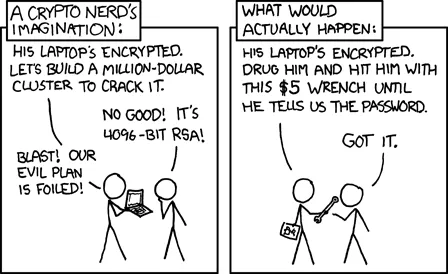
- Like all other methods, still susceptible to the $5 wrench attack if the attacker knows you own the coins
Storing the seed phrase digitally online
This is almost certainly a bad idea. Only do this if you really know what you’re doing, or if you have so little money stored that you aren’t worried about losing it all.
- Can easily be hacked - If the machine has access to the internet there are myriad ways that a hacker could steal your coins.
- Hard to lose - You can easily backup multiple copies of the phrase
- Difficult to destroy - You can back the files up using the cloud
- Unlikely a physical break-in to your home will result in a loss
Storing the seed phrase digitally offline
Storing the phrase digitally is usually a bad idea, but if you’re going to do it then at least doing it on a machine that doesn’t have internet access is preferable.
- Can’t easily be hacked unless someone gains access to the device
- Easily lost - Since the seed probably isn’t on multiple offline devices if you lose the one it’s on you’re out of luck.
- Easily destroyed in a house fire or even simple hardware malfunction
- Unlikely a physical break-in to your home will result in a loss
Every person and organization will have different preferences for how to store seed phrases. Factors that should influence this decision include the amount of crypto being stored, the technical abilities of the owners, and also tolerance for inconvenience.
Related Articles
Security in Dependencies
Aug 21, 2019 by Lane Wagner - Boot.dev co-founder and backend engineer
Choosing the right dependencies is a difficult task. Assuming the developer of an application is the best programmer in the world, the “best” thing to do would be to write the entire codebase alone. This would eliminate the bugs, vulnerabilities, and malicious intrusions of inferior developers.
Creating and Remembering a Strong Passphrase
Aug 03, 2019 by Lane Wagner - Boot.dev co-founder and backend engineer
We all have hundreds of online accounts. Ideally, as many of those accounts as possible have unique passwords. Unique passwords however present a difficult problem.
BIP 32 Watch-Only Wallets
Jul 25, 2019 by Lane Wagner - Boot.dev co-founder and backend engineer
Bitcoin improvement proposal 32 is, in my opinion, one of the most important BIPs we have. (Thanks Peter Wuille!) BIP 32 gave us Hierarchical Deterministic Wallets, which grant the ability to create a tree of keys from a single seed.
Trustworthy vs Trustless Apps
Jul 23, 2019 by Lane Wagner - Boot.dev co-founder and backend engineer
In the wake of the hearings about Facebook’s new Libra blockchain, it is more important than ever that we all understand the difference between trustworthy and trustless apps.